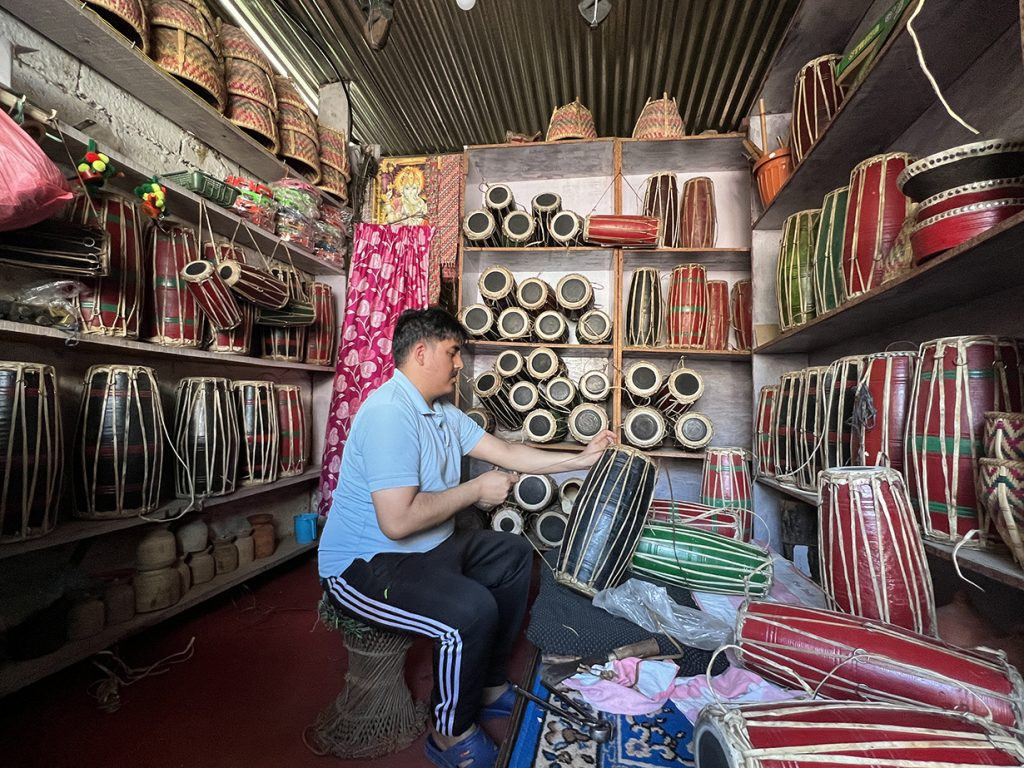
Dhorpatan (Baglung). The importance of Madal is connected with Nepali folk culture. Madal is also a favorite
for music connoisseurs. Every folk song is incomplete without Madal.

It is used in all cultural activities of Nepali society. Be it Tihar festival or any other festival, Madal
is celebrated everywhere in the village and city. When the rhythm of Madal plays, then every person's heart
is full of joy. Recently, not only music connoisseurs, but also businessmen who make madals are worried
that the use of madals is decreasing.
At this time, everywhere in the village and city, there is the excitement of Tihar. Earlier, the tune of
Madal played by Deusi Bhailo players used to be heard far and wide, but now-a-days Madal is played less
often.

The teams playing Deusibhailo during Tihar had already bought Madal a month before. The cultural teams
playing Daiusibhailo used to buy Jor Madal. But this year, Madal businessmen of Baglung are worried because
Madal is not sold even though Tihar has arrived.
Among the cultural instruments of Nepal, Madal is the identity of the Nepali people who enjoy playing it
especially during Tihar and various festivals.

Businessmen who have saved hundreds of dollars during this time in the past years are currently waiting
for customers in the sun. During Tihar, groups who perform cultural programs by singing and dancing buy
madals, but the madal business has started to suffer as the number of people enjoying western culture and
modern bazaagaza is increasing.
Lately, whether it is Deusi Bhailo or any program, the new young generations enjoy mobiles, decks and big
speakers. The dances that were danced to the rhythm of Madal have also disappeared. In the name of modern,
pop and remix, the attraction towards Madal is decreasing among the young generation.

During Tihar a decade ago, around 500 madals used to be sold from a single shop, but during this year's
Tihar, not even 10 were sold, the businessmen here complain.
Traders who have been doing Madal business for years in different places of Baglung are now very worried.
Earlier, during Dasain Tihar, there was a lot of demand for madals from villages and towns, but now even
the madals made three years ago are not sold, says Pirtambar Darzi, a local.

The tailors lamented that the trade of Madal has decreased along with the disappearance of traditional
handicrafts as the Jamaat enjoying modern handicrafts has increased.
"The profession is going down, I'm afraid of making a living, what can I do with only skills in my hands?
The goods I make are not sold. I spent more than half my life in this profession, now I'm getting old,
what can I do, I could even make a living" he said. , 'There used to be a crowd of people in the shop,
they could not deliver the madal according to the demand, now no one comes, the shop opened all day, they
painted the old madal and made new ones, there is no other achievement except the grinding of Tuna
Khuskaka.'
Encouragement of foreign art, culture and instruments, but due to lack of proper protection of Nepali
original culture and instruments, the culture itself is starting to disappear. Different castes have
their own art and culture in Baglung. During every festival, they sing, play and have fun according to
their customs.
Due to the migration of the young generation and the elderly not being able to use it, the use of Madal
has decreased and the original culture has also disappeared. Dil Bahadur Nepali, who has been in the madal
business for twenty-seven years, complained that the business itself is in crisis because the government
is unable to protect the bajas along with the original culture.

Recalling that in the past, they used to make madal for Tihar all year round and save it for a month,
he said that the madal made before was not sold and was stored in the godown until today.
He says that in order to protect the madal business, the government should include a curriculum on Nepali
original bazaa at the village school level. Nepalis say that if all the 10 municipalities of the district
discourage western culture for the sake of preserving art and culture, the Madal business will flourish and
the local culture will be revived.

He said that the Madal produced by him reaches Gulmi, Palpa, Arghakhanchi, Rolpa, Rukum, Parbat, Myagdi
and Butwal from different places in Baglung district and now there is no demand from anywhere.
He says that all the raw materials used to make Madal are Nepalese. The Nepalese said that with the decrease
in the demand for Madal, they also stopped getting raw materials. According to him, Madal business has
decreased by 95% even though there is more Madal business during Tihar than other times.

He remembers that people who used to go to Videl used to buy madal from where he was.
Nepali says, 'It's been 22-22 years since I started making madals, when I started, many people used to say
that I work with leather, I used to be sadder than that, after I started making money by selling madals, I
didn't pay any attention to what they said. , the family was doing well, children were educated and brought
up from here, Madal was made throughout the year, it was sold when Tihar came, even if it was taken to a
fair, it was sold.
Many people understand that there has been a decrease in the sale of medals due to the development of
information and technology in recent times. After the Baja Madal business, which is associated with Nepali
originality and tradition, is in crisis with modernity, the businessmen are also fleeing.

Nowadays, those who play Deusi Bhailo buy an electronic sound system. A minimum of five thousand is
required for the sound system. But Madal is available for two thousand five hundred rupees.
Deusi bhailo players buy speakers and microphones even when the music is cheap. Local 67-year-old Dal Bahadur
 Gharti Magar said that Bhailo players do not show original songs and dances like before.

He said that he used to sing old original songs, play Madal, Jhyali and play Deusi Bhailo during Tihar, but
 now all that is disappearing. In his time, he used to show dances such as Sorathi, Maruni and others during
Tihar, but he says that such dances are disappearing due to lack of interest in the present youth generation.
 Rss